New research highlights the potential of portable qcLAMP technology to detect Botrytis cinerea in tomato plants before visible disease symptoms develop, using simplified plant extracts.
Early detection of plant pathogens is essential for effective crop protection. Yet, many plant diseases remain undetected until visible symptoms develop, potentially limiting opportunities for timely intervention.
A new research preprint, co-authored by BIOPIX-T researchers in collaboration with the Hellenic Mediterranean University, the University of Crete, and the Foundation for Research and Technology-Hellas (FORTH), presents a portable molecular workflow for the early detection of Botrytis cinerea, the fungal pathogen responsible for grey mould in tomato crops.
Bringing Molecular Testing Closer to the Field
The research combines BIOPIX-T’s PEBBLE® portable qcLAMP platform and Universal Mastermix with an optimized LAMP assay and a simplified, water-based sample preparation protocol.
Rather than developing an entirely new set of primers, the researchers adapted previously established primers to BIOPIX-T’s reaction chemistry and real-time colorimetric detection system.
This integrated approach enables molecular detection directly from crude plant extracts, without conventional DNA purification, reducing dependence on complex laboratory sample preparation.
Key Research Findings
1. Detection Before Visible Symptoms
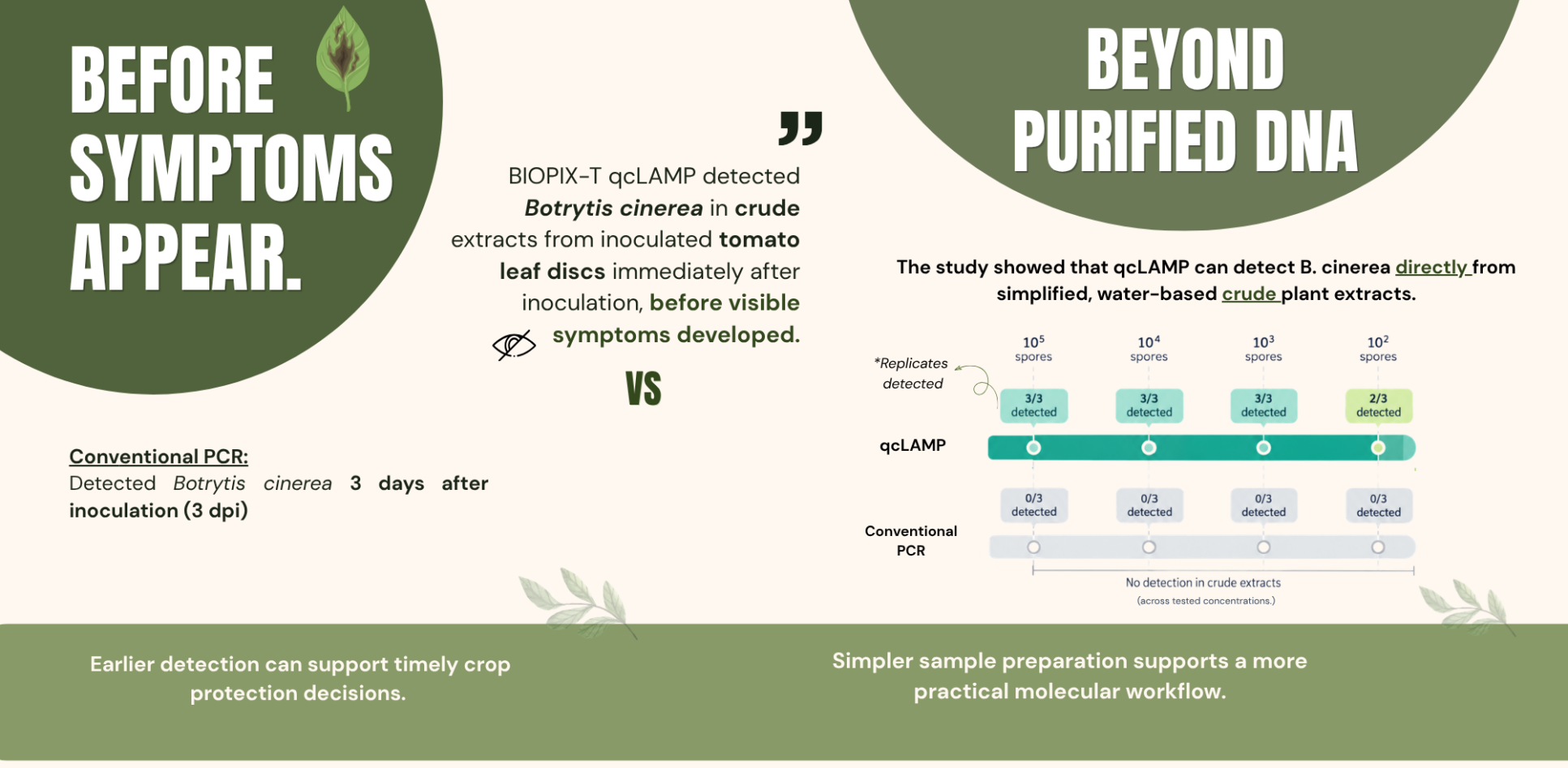
The qcLAMP workflow successfully detected B. cinerea immediately after experimental spore deposition (0 hours post-inoculation), before visible symptoms developed.
In comparison, conventional PCR detected the pathogen from two days post-inoculation using purified DNA, and from three days using crude extracts.
These findings highlight the potential of earlier molecular detection to support more timely crop protection decisions.
2. Sensitive Detection Without Conventional DNA Purification
The assay demonstrated 97.96% sensitivity, 100% specificity, and 98.70% accuracy across 77 evaluated DNA templates, with an analytical detection limit of 1 pg of genomic DNA per reaction (approximately 20 genome copies).
Importantly, qcLAMP detected as few as 100 fungal spores in water-based crude plant extracts in two of three experimental replicates. Conventional PCR, under the tested conditions, failed to detect the pathogen in crude extracts across all evaluated spore concentrations.
This demonstrates the value of combining sensitive molecular amplification with simplified sample preparation.
3. Evaluation Using Real Greenhouse Samples
The workflow was further evaluated using naturally infected tomato leaf samples collected from a commercial greenhouse in Crete, Greece.
Using crude extracts, qcLAMP detected B. cinerea in 20 out of 20 symptomatic samples and 9 out of 20 apparently healthy samples, highlighting its potential for detecting the pathogen even in the absence of visible disease symptoms.
These results support the development of molecular testing approaches suitable for future applications closer to agricultural sampling sites.
Beyond a Single Pathogen
The significance of this research extends beyond the detection of Botrytis cinerea.
By integrating portable instrumentation, optimized reaction chemistry, and simplified sample preparation, the study demonstrates how established molecular assays can be adapted into more accessible, field-oriented workflows.
While further validation and application-specific assay development remain necessary, this approach creates opportunities for investigating additional plant pathogens and expanding the use of portable molecular technologies across agriculture and other research fields.
For BIOPIX-T, the study represents another example of how PEBBLE® and Universal Mastermix can support the translation of molecular research into practical testing workflows, bringing advanced molecular analysis closer to real-world needs.
BIOPIX-T research was funded by K&N Efthymiadis S.A. (Redestos Group)